
Even though Australia’s Hervey Bay is known as the whale-watching capital of the world, the U.S. also boasts many exciting whale-watching spots, particularly in winter. But what if you accidentally witnessed a whale that had also been spotted 35 years ago? Sounds unbelievable, but that’s exactly what happened off the coast of Mexico.
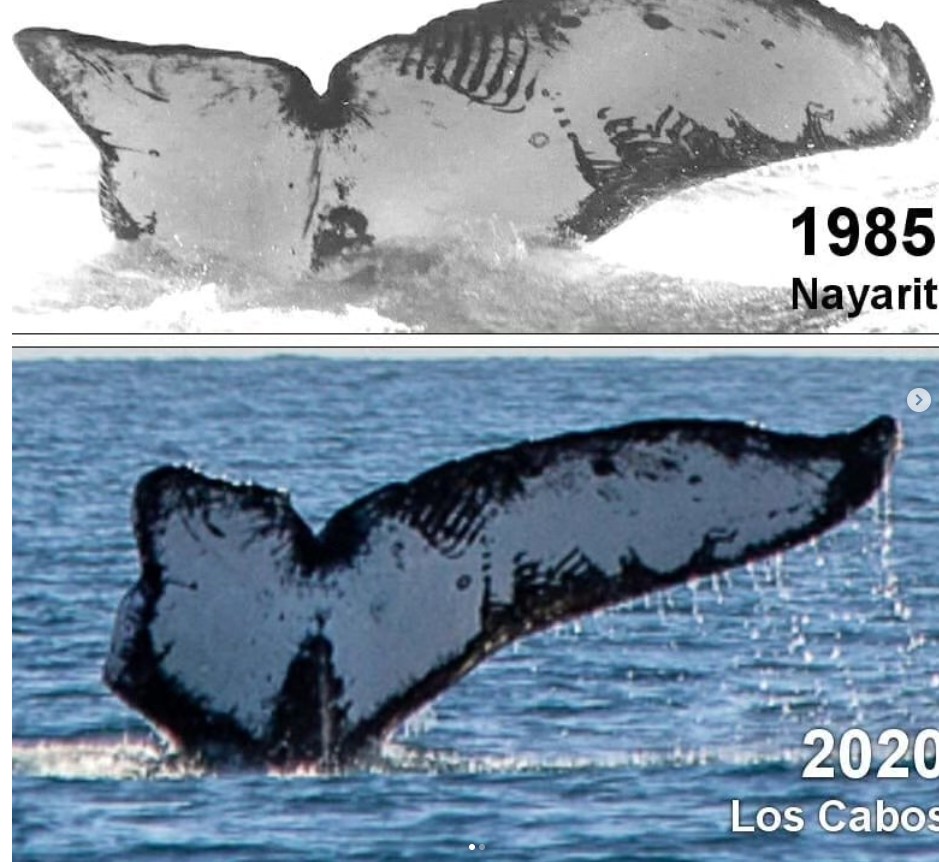
A humpback whale, with a distinct injury on its tail fluke, was photographed off the coast of Mexico in 1985 and then again in 2020. This remarkable re-sighting is not only a wildlife miracle but also highlights the incredible resilience and longevity of these majestic marine mammals. Let’s find out more about this fascinating and inspiring story.
A Whale’s Tale: The Humpback Whale Photographed 35 Years Apart
While experts are noticing a rising number of humpback whale deaths on the East Coast, this story of a humpback photographed 35 years apart is even harder to believe. It all began when a Reddit post in 2020 sparked widespread discussion about whether the whale pictured in an older image was the same one captured in a newer photograph.
The whale in question, according to the post, was first photographed in 1985 off the coast of Nayarit and then again in 2020 near Los Cabos. The whale was considered the same because of an identical fluke injury.
Some believed it could be the same whale because of matching scars and fluke patterns. Others disregarded the theory, saying how could a 1985 picture be of better quality than a 2020 picture, while others suggested it was simply a coincidence involving two different whales.
But it turns out the images and the story behind them are true. The whale is indeed the same one, having been officially identified as CRC-10724 by Cascadia Research Collective and collaborators (as mentioned on the Happywhale).
So, images aside, what is the larger story of this whale’s incredible journey and the sightings of it over the last few decades?
This humpback whale, with distinct markings on its body and tail, shot into the limelight after Proyecto Pupila, a travel and film company based in Baja California Sur, Mexico, specializing in underwater experiences, personalized expeditions, filmmaking, and photography, shared two photos on its Instagram account on April 7, 2020. The post quickly generated great interest and discussion on Reddit.
The post featured two photos of a humpback whale, one from 1985 off the coast of Nayarit, taken by the Research Group of Marine Mammals of the Faculty of Sciences of the UNAM, and the other from 2020, captured by Proyecto Pupila off the coast of Los Cabos. The post also said:
Since 1985, 35 years ago, CRC-10724 (Humpback Whale) has visited the waters of Mexico, in Nayarit in 1985, and in Los Cabos since 2017 there have been photographic records and identification, very important to know the movement, location of the species, patterns, growth or modifications of migrations, and other tools that help monitor this species.
This post states that this humpback whale, identified as CRC-10724, has been regularly spotted in Mexican waters. The post also explained that those interested in learning about the whale’s journey, sightings, and photos over the years can see more on the animal’s Happywhale profile.
The pictures and other data available on Happywhale indicate how researchers use marine animals’ unique physical features in tracking them. The post also highlights the importance of photo identification in long-term wildlife monitoring.
The Remarkable Re-Sighting(s) Of The CRC-10724 Humpback Whale
The humpback whale, CRC-10724, has an extraordinary story that spans nearly four decades. According to Happywhale, this humpback survived a brutal attack, which left a large portion of its left fluke missing. This missing fluke, along with other markings on its body and tail, became its distinct identification, helping researchers to track it for around four decades.
The Happywhale page has over 99 photos documenting the CRC-10724 whale’s journey. It has been sighted 35 times between January 1, 1985, in Nayarit, Mexico, and October 21, 2024, off the coast of California, United States.
This incredible collection is the effort of Cascadia Research Collective and collaborators, as well as the ECOBAC team in Mexico. With the help of the photos available in the FIBB catalog (Photo-identification catalog of humpback whales of Banderas Bay, Mexico), the page provides vital details about the whale’s sightings and journey.
Humpback whales are truly fascinating. CRC-10724’s images and sightings prove just how extraordinary long-term marine monitoring can be.